What Is AI-Ready Data?
The Difference Between Data an Agent Can Read and Data an Agent Can Trust
19 min read
What is AI-ready data?
AI-ready data is data an AI system can query correctly and safely without having to guess what it means. It carries its own business definitions, relationships, context, and access rules, so that when an agent asks a question, the answer it gets back is the organization's actual answer rather than a plausible reconstruction assembled from column names.
AI-ready data is not simply clean data. It is not data that has been cataloged. It is not data that has been loaded into a vector store or fed through a retrieval pipeline. Each of those helps, and none of them, on its own, makes data ready for an agent to reason over. Readiness is about whether meaning travels with the data, because an AI system has no other reliable way to recover it.
The distinction matters because the industry is racing to connect agents directly to warehouses, and most of that data was structured for a very different consumer. It was structured for humans who already knew what the columns meant.
Why raw data is not AI-ready
For the last fifteen years, the implicit standard for "usable data" was set by human analysts. A person who opens a warehouse and sees a table called fct_txn with columns amt, rev_adj, and order_total_v2 does something an agent cannot: they ask around. They Slack a teammate, they check a dashboard they trust, they remember that _v2 was the fix after the billing migration, and they notice when a number looks wrong because they have a mental model of what "about right" is.
That resilience hid an enormous amount of missing structure. The meaning of the data was never actually in the data. It lived in people's heads, in tribal knowledge, in the institutional memory of a few senior analysts, and in a pile of undocumented SQL. Humans compensated for that gap so smoothly that most organizations never had to close it.
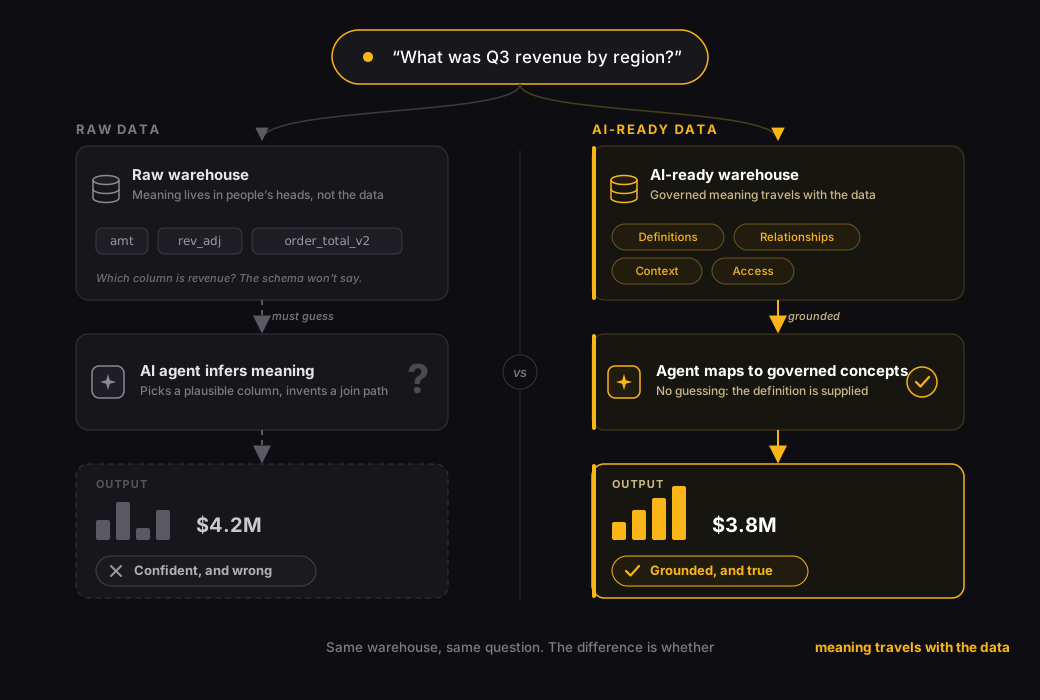
An AI agent removes the compensation and exposes the gap. Point a large language model at that same schema, ask it for quarterly revenue, and it will do what any text-to-SQL system does: pick a column that looks plausible, invent a join path, skip the refund netting it has no way to know about, and return a confident, well-formatted, wrong answer. It does not ask around, because it has no one to ask. The context that made human analysts effective is precisely the context an agent never receives.
This is the core reason raw data is not AI-ready. The data is technically accessible, and it is semantically opaque. An agent can read every value in the table and still have no idea what the table is for.
Why you can't just point a model at your database
A reasonable-sounding intuition sits behind a lot of stalled AI-on-data projects. The model is obviously intelligent, so surely you can hand it the database, ask for the analysis, and get the answer back. It does not work that way, and the reason is rooted in what a generative foundation model actually is.
A large language model is trained, at its core, to do one thing: predict the next token in a sequence, given the tokens that came before it. Run that objective across a large fraction of the text on the internet and the model learns the statistical structure of language, and with it a great deal of the structure of the ideas that language encodes. That is what produces the fluency. It is also what sets the limits. The model is optimizing for the most plausible continuation, not the most correct one. On most questions people ask, plausible and correct overlap closely enough to be useful. On exact arithmetic over your specific data, they come apart.
Three consequences follow, and each one bites in data work.
A model does not hold your database; it reads tokens. A foundation model has a finite context window and no query engine inside it. You cannot load a warehouse into it. Even pasting in a sample of rows does not hand the model a table it can scan and index. It hands the model text, which it processes the way it processes any other text. There is no GROUP BY running inside the forward pass.
A model approximates computation; it does not perform it. Ask a model to add up a column of numbers you have pasted in, and it returns the number that most plausibly follows, based on patterns in its training data. For a short, clean example it may land on the right value. As the input grows the approximation drifts, because nothing in the mechanism is actually adding. A regression is the sharpest illustration. Fitting coefficients means running a numerical optimization over the full dataset, and a forward pass does not do that. A model can describe what a regression on your data would probably show, in the confident register of something that has read thousands of regression write-ups, but that description is not a computation.
A model has no connection to your data unless something gives it one. The weights encode patterns from the public web, not the contents of your fct_txn table. Out of the box the model has no idea what your revenue is, because your revenue was never in its training data and never could be. It knows only what it is shown, and, per the point above, showing it the raw table does not let it compute over the table.
None of this is a knock on the models. It is a description of the right division of labor. What foundation models are genuinely good at is language and intent: taking a messy human question and working out what is being asked. What deterministic systems are good at — the warehouse, the query engine, a real statistics library — is computing an exact, reproducible answer. The productive pattern is not to make the model do the math. It is to let the model translate the question into a correct, governed query or a piece of runnable code, and let a real engine execute it against the real data.
That pattern only holds if the translation step is grounded. A model asked to turn "what was margin by region last quarter" into SQL still has to know what margin means in your business, which tables carry it, and how the joins go. Give it a raw schema and it is back to guessing at the query, having only moved the guess one step upstream. Give it governed definitions and the translation becomes reliable, because the meaning it needs is supplied rather than inferred. Supplying that meaning, in a form the model can reason with and an engine can execute, is what making data AI-ready comes down to.
AI-ready vs. analytics-ready vs. "clean"
Because the term is new, it gets used loosely, and it is easy to assume you have AI-ready data if you have invested in data quality. These are related but genuinely different bars.
| What it means | What it does not guarantee | |
|---|---|---|
| Clean data | Values are accurate, complete, deduplicated, and correctly typed | That anyone, human or machine, knows which combination of clean tables constitutes "revenue" |
| Analytics-ready data | Modeled and shaped for querying: conformed dimensions, declared grains, a sensible star schema | That the business meaning on top of that structure is defined, governed, and machine-readable |
| AI-ready data | Carries governed definitions, relationships, context, and access rules that an agent can consume and compute against | Nothing further: this is the bar where meaning travels with the data |
The progression is cumulative. You generally cannot have AI-ready data without clean, well-modeled data underneath it, which is why data quality and dimensional modeling remain foundational rather than obsolete. But the top rung is the one AI actually stands on, and it is the one most data programs have not built. Clean, cataloged, analytics-ready data is a warehouse an agent can read. AI-ready data is a warehouse an agent can be trusted with.
Try a blunt test. If you handed your schema to a competent analyst who had never worked at your company, along with everything an agent would receive, could they compute your core metrics correctly on the first try? If the honest answer is no, your data is not yet AI-ready, no matter how clean it is.
The characteristics of AI-ready data
Readiness is not a single switch. It is a set of properties that together let an agent move from guessing to grounding. Six characteristics matter most.
1. Defined. Every business concept an agent might be asked about — revenue, active customer, margin, churn — has one governed definition: which tables, which joins, which filters, which exclusions. The definition is written once and lives in one place, rather than being re-derived by whatever consumer happens to ask. An agent should never be in the position of inferring what a metric means, because inference is exactly where confident wrong answers come from.
2. Contextualized. Beyond the calculation, AI-ready data carries the descriptive context an agent needs to map a human question onto the right concept: plain-language descriptions, synonyms (a user asking about "sales" and a user asking about "bookings" may mean the same measure, or two different ones), and business glossary context. This is the material that lets an agent reason about ambiguity instead of resolving it by coin flip.
3. Connected. The relationships between entities are declared, not left for the agent to reconstruct. Orders belong to customers, subscriptions belong to accounts, and the correct join paths follow from that. This is where ad-hoc generated SQL most often goes silently wrong: a fan-out join that double-counts revenue produces a number that looks entirely reasonable and is entirely false. Declared relationships remove that class of error before it happens.
4. Governed and permissioned. AI-ready data enforces access at the level of the concept, not the query. If a user is not allowed to see customer-level financials, that rule holds no matter how the question is phrased, which tool issued it, or how creatively an agent tries to assemble the answer. An agent that can be talked into exposing data a user should not see is not operating on AI-ready data, however well it answers.
5. Tested and trustworthy. Definitions are validated the way software is: revenue reconciles to the finance system within tolerance, active-user counts are never negative, regional figures sum to the total. Data that silently drifts is worse than data with no definitions at all, because it drifts with authority. An agent will report the drifted number as confidently as the correct one.
6. Accessible to agents. Finally, all of the above has to be reachable through the interfaces agents actually use. In practice that increasingly means MCP for agent access alongside REST and JDBC/ODBC for everything else. Definitions that are perfectly governed but trapped inside a single BI tool are not AI-ready, because the agent cannot get to them.
Read those six together and a pattern emerges. AI-ready data has to do two jobs at once: give an agent enough context to reason about a question, and give it a governed, computable path to produce the answer against live data. Context without computation leaves an agent describing answers it cannot actually generate. Computation without context leaves it generating answers to questions it has misunderstood. Readiness is the intersection.
The failure mode: confident, wrong, and unreviewed
When data is not AI-ready, the failure is not loud. It is quiet, and that is what makes it dangerous.
When an agent guesses at meaning, it does not return an error. It returns a number. A number rendered on a chart or dropped into a sentence carries an authority that a paragraph of prose does not, because everyone has been trained to treat quantified answers as the output of a calculation rather than a guess. Nobody fact-checks a bar chart. This is the hallucinated metrics problem, and it is more corrosive than a hallucinated fact in text precisely because it looks like rigor.
The problem compounds at scale in a way human error does not. A human analyst who misdefines a metric does it once, and the mistake is usually caught in review. An agent serving a thousand natural-language questions a day makes definitional guesses a thousand times a day, with no review step, for users who reached for natural language because they could not validate the SQL themselves. The people least equipped to catch the error are the ones receiving the most answers.
This is the gap between how much an agent seems to know and how much it actually does, and it does not close on its own as models improve. A better model guesses more fluently. It does not guess your refund policy. The only thing that closes the gap is giving the model the definitions to stand on, which is what making the data AI-ready means.
How to make your data AI-ready
The work is concrete, and it follows a consistent path regardless of tooling. It also overlaps heavily with good analytics engineering, which is the good news: much of this is discipline you already recognize, pointed at a new consumer.
1. Start where the arguments are. Inventory the metrics that already cause disagreement, the ones that appear on different dashboards with different values. Those are the definitions an agent will get wrong first, because if your own teams cannot agree on them, a model has no chance. For each, document every variant in production and who owns it. This step is archaeology more than engineering, and it is where most of the organizational effort lives.
2. Model the structure underneath. AI-ready meaning sits on top of well-modeled data. If the physical and dimensional layers are tangled, defining clean semantics on top of them is nearly impossible. Conformed dimensions, declared grains, and a sensible star schema are what make the semantic definitions almost mechanical to write. Our data modeling guide covers this end to end.
3. Define meaning once, in code. For each concept, get the owning stakeholders to agree on one canonical definition and express it declaratively: entities, dimensions, measures, and relationships, with the calculation logic in readable SQL. Put it in version control, review it like code, and keep the SQL visible rather than buried. Definitions that live in a wiki are documentation. Definitions that live in the query path are infrastructure.
4. Add the context agents need. Layer in the descriptions, synonyms, and glossary entries that let an agent map a messy human question onto the right concept. This is the difference between a definition a machine can execute and a definition a machine can find when someone asks for it in their own words.
5. Test and govern. Write assertions against the definitions and run them on every change. Route changes through the metric owner. This is the step that separates AI-ready data from a folder of agreed-upon queries: the governance process is the product, because it is what keeps the definitions true over time.
6. Serve it to agents. Expose the whole thing over the interfaces agents use, MCP chief among them, so that the same governed definitions answer questions whether they arrive from a BI tool, a notebook, an application, or an AI agent. The value of AI-ready data is proportional to the share of AI queries that actually flow through the governed path. Data that grounds thirty percent of agent traffic leaves the other seventy percent guessing.
The semantic layer is the mechanism
Those six characteristics and six steps add up to a description of a semantic layer, and not by coincidence. The semantic layer is the architecture that makes data AI-ready, because it is the one place in the stack designed to hold meaning rather than store values.
A semantic layer maps physical tables to business concepts, encodes definitions and relationships once, enforces governance at the concept level, and serves the result to every consumer over open interfaces. Framed for a human audience, that is a translation layer that keeps dashboards consistent. Framed for an agent, that same layer is exactly what turns opaque data into grounded data. The semantic layer for AI is not a different product than the semantic layer for BI. It is the same layer, serving a consumer that needs it far more, because that consumer cannot compensate for its absence.
This is why the industry is converging here. Anthropic's own engineering work on building analytics agents reached the same conclusion: agents need a semantic layer to produce reliable answers over enterprise data. And Apache Ossie (incubating), formerly the Open Semantic Interchange and backed by a broad coalition of data vendors, is standardizing how semantic definitions are expressed and exchanged, precisely so that meaning defined once can ground any tool or agent. AI-ready data is becoming a shared standard, not a proprietary trick.
The one caution worth carrying forward: a semantic layer only makes data AI-ready if it does both jobs. A layer rich in context that sits beside the data, describing it without computing against it, leaves agents with well-annotated answers they cannot actually produce. A layer that computes but carries no context leaves them executing questions they have misread. Readiness requires context an agent can reason with and a governed, performant connection to the data so the answer is computed, not merely described.
Frequently asked questions
What does "AI-ready data" actually mean?
It means data an AI system can query correctly and safely without guessing what it means. The definitions, relationships, business context, and access rules travel with the data in a machine-readable, governed form, so an agent maps a question onto concepts that already carry their own correctness instead of reconstructing meaning from column names.
Isn't clean, cataloged data already AI-ready?
No. Clean data guarantees the values are accurate. A catalog documents what data exists and what someone wrote about it. Neither one puts the governed definition of "revenue" into the query path where an agent will compute it. An agent can read a perfectly clean, fully cataloged warehouse and still generate a confident wrong number, because the meaning it needs was described for humans, not encoded for machines.
How is AI-ready data different from analytics-ready data?
Analytics-ready data is modeled and shaped for querying: conformed dimensions, declared grains, a sound star schema. That is necessary but not sufficient. AI-ready data adds the governed semantic layer on top, defining and enforcing what the modeled structure means, so the meaning is available to an agent and not just to an analyst who already knows it.
Why can't a more capable model just figure out my data?
Because the missing information is not in the data. Your refund netting, your definition of "active," the reason a _v2 column exists: none of it can be inferred from a schema, however capable the model. A better model produces a more fluent guess, not a more correct one. Grounding, not raw capability, is what makes answers reliable.
Do I need a vector database or RAG to make data AI-ready?
Retrieval techniques help an agent find relevant context, but they do not define or govern your metrics. Retrieving a document that mentions revenue is not the same as computing revenue the way finance signed off on. For structured enterprise data, readiness comes from governed definitions in the query path, which is the semantic layer's job. Retrieval and a semantic layer are complementary, not substitutes.
What is the first step toward AI-ready data?
Inventory the metrics your own teams already disagree about, and get the owners to agree on one canonical definition for each. If your organization cannot state a single correct definition of a metric, no amount of tooling will make an agent get it right. The definitions come first; the technology serves them.
Where Coginiti fits
Coginiti treats AI-ready data as a lifecycle, not a file of definitions. Most tools in this space let you declare metrics. The harder problem is everything around the declaration, and that is where the platform is built to operate. Definitions are expressed as code in the SQL your analysts already know, using CoginitiScript for transformation and Semantic Model Definition Language for the model, then tested with assertions, versioned and governed through review, and served to every consumer over REST, JDBC/ODBC, and MCP across 21+ data platforms, from cloud warehouses to on-prem and air-gapped environments.
The reason this produces genuinely AI-ready data comes back to the two jobs. Coginiti's semantic layer is built as a semantic graph — entities, relationships, and context rather than a flat metric list — and it stays in the query path: that context compiles to governed SQL pushed down to the engine, so answers are computed against live data at warehouse scale rather than retrieved from a description of it. That combination is what gives Coginiti's AI agents, and yours, ground they can both reason with and execute on.
If you want the architecture beneath this, What Is a Semantic Layer? covers the mechanism in depth, and Data Modeling for Analytics covers the foundation it stands on.
See Semantic Intelligence in Action
Coginiti operationalizes business meaning across your entire data estate.