What Is a Semantic Layer?
Definition, Architecture, and Why AI Changed the Stakes
21 min read
What is a semantic layer?
A semantic layer is a governed translation layer that sits between raw data and the people, tools, and AI agents that consume it. It maps physical tables and columns to business concepts — customers, revenue, churn — and encodes the definitions, relationships, and calculation logic in one place, so every consumer gets the same answer to the same question.
Ask three teams at the same company what "revenue" means and you'll often get three answers. Finance recognizes it on a GAAP schedule. Sales counts bookings the moment a contract is signed. The product team sums order_total from the events table, refunds included. All three are reasonable. All three are different. And all three end up on dashboards in front of executives who assume they're looking at the same number.
A semantic layer resolves this by acting as a contract between your data and everything that consumes it. The definition of revenue — which tables, which joins, which filters, which exclusions — is written once, versioned, governed, and served everywhere. Your BI tool, your notebook, your spreadsheet plug-in, and your AI agent all query the concept "revenue" and the semantic layer translates that request into correct SQL against the underlying warehouse.
A useful analogy: the semantic layer is to your data what an API is to your application. Consumers don't need to know how the internals are implemented. They ask for a well-defined thing by name, and they get a consistent, governed response.
Why semantic layers exist: the metric consistency problem
Semantic layers weren't invented for AI. They were invented because metric definitions drift, and drift is expensive.
The pattern is familiar to anyone who has run a data team:
Metric drift. A definition starts clean: "active user" means logged in within 30 days. Then one team excludes internal accounts, another switches to a 28-day window to smooth weekday effects, and a third copies a six-month-old version of the query from a Slack thread. Within a year, "active users" appears in four dashboards with four values, and nobody can say which one is right because, locally, they all are.
Conflicting dashboards. When two executives walk into a meeting with different numbers for the same KPI, the meeting stops being about the decision and becomes about the data. The analytics team spends the next two days reconciling queries instead of doing analysis. This reconciliation tax is invisible in any budget line, but it's one of the largest recurring costs in most data organizations.
Tribal knowledge loss. In many companies, the real metric definitions live in the heads of two or three senior analysts and in a pile of undocumented SQL. When those people leave, the definitions leave with them. New hires reverse-engineer logic from old queries and guess at the intent.
The cost is not hypothetical. Gartner has estimated that poor data quality costs organizations an average of $12.9 million per year (Gartner, 2021), and inconsistent metric definitions are one of the most common and most preventable forms of it. The damage isn't just rework; it's eroded trust. Once a leadership team has been burned by conflicting numbers, every future number gets discounted, and the organization quietly reverts to gut-feel decision-making with a data veneer.
A semantic layer attacks this at the root: one definition, defined once, consumed everywhere, changed through a governed process rather than a copy-paste.
Semantic layer architecture: how it works
The components
Most semantic layers, whatever the vendor or framework, are built from four primitives:
-
Entities are the business objects your organization reasons about: customers, orders, accounts, subscriptions. Each entity maps to one or more physical tables and carries a primary key that establishes its identity.
-
Dimensions are the attributes you slice by: region, plan tier, signup date, sales rep. Dimensions can be physical columns, derived expressions, or time grains computed from a timestamp.
-
Measures are the quantitative calculations: revenue, count of active users, average order value, net retention. A measure encodes not just the aggregation function but the full business logic: which rows qualify, which are excluded, how nulls are handled.
-
Relationships define how entities connect — orders belong to customers, subscriptions belong to accounts — so the layer can generate correct joins automatically. This is where most ad-hoc SQL goes wrong (fan-out joins silently double-counting revenue is a classic), and where a semantic layer earns its keep.
Together these primitives form a semantic model: a machine-readable description of what your data means, not just where it lives. In knowledge-graph implementations, these same primitives are expressed as nodes and edges, which lets the layer reason over indirect relationships as well as direct ones.
Where it sits in the modern data stack
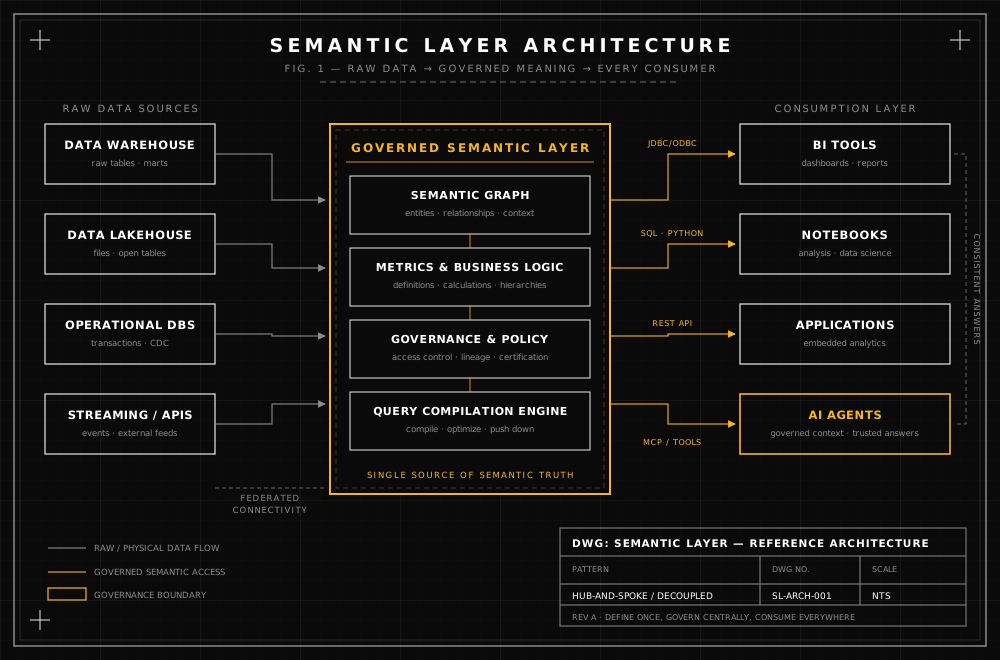
The semantic layer occupies a specific position: above storage and compute, below consumption.
Below it sits your warehouse or lakehouse: Snowflake, Databricks, BigQuery, Redshift, Trino, or any of the engines where the physical data lives and queries execute. The semantic layer does not store or move data. It stores meaning, and pushes computation down to the engine.
Above it sit the consumers: BI tools like Tableau and Power BI, notebooks and IDEs where analysts work in SQL and Python, embedded analytics in customer-facing applications, spreadsheets, and AI agents that answer natural-language questions about the business. That last group is increasingly the reason organizations adopt one.
This positioning is what people mean by a universal semantic layer: a single layer that serves all consumers, rather than a definition trapped inside one BI tool. If your semantic model lives inside Tableau, it governs Tableau and nothing else; your notebooks and your AI agents are back to guessing. A universal semantic layer decouples definitions from any single consumption tool, typically exposing them over standard interfaces (JDBC/ODBC, REST, and increasingly MCP for agent access) so the same governed definition answers every query, regardless of where it originates.
Query flow: what happens when a tool asks for "revenue"
The mechanics are easier to see with a worked example. Suppose an analyst — or an AI agent — asks for monthly recurring revenue by region for the last two quarters.
Without a semantic layer, someone writes this from scratch:
SELECT
    c.region,
    DATE_TRUNC('month', s.invoice_date) AS month,
    SUM(s.amount) - SUM(COALESCE(r.refund_amount, 0)) AS revenue
FROM billing.subscriptions s
JOIN crm.customers c ON s.customer_id = c.id
LEFT JOIN billing.refunds r ON r.subscription_id = s.id
WHERE s.status = 'active'
  AND s.is_test_account = FALSE
  AND s.invoice_date >= DATEADD('month', -6, CURRENT_DATE)
GROUP BY 1, 2;
Every clause in that query is a decision: which join keys, whether refunds net out, whether test accounts are excluded, what "active" means. Each decision is a place where two analysts can diverge, and they do.
With a semantic layer, the request is expressed against the concept:
SELECT
    customer.region,
    subscription.invoice_month,
    MEASURE(revenue)
FROM semantic_model
WHERE subscription.invoice_month >= DATEADD('month', -6, CURRENT_DATE)
GROUP BY 1, 2;
The MEASURE(revenue) call resolves to the governed definition: the layer knows which tables hold the data, generates the joins from declared relationships, applies the refund netting and test-account exclusion automatically, and compiles the whole thing into optimized SQL for whatever engine sits underneath. The analyst writes intent; the layer supplies correctness.
Three things happen in that translation step, and they're the heart of the architecture:
- Resolution. The semantic name (
revenue) is resolved to its full definition — sources, joins, filters, aggregation. - Compilation. The layer generates engine-specific SQL, handling dialect differences and join-path selection.
- Governance. Access policies apply at the concept level. If a user can't see customer-level financials, the layer enforces that no matter which tool issued the query.
The three things people mean by "semantic layer"
Much of the confusion here comes from one term covering three genuinely different architectures. When two practitioners argue about whether semantic layers are worth it, they're often arguing about different things. (We've written a full breakdown in The Three Meanings of "Semantic Layer"; here's the short version.)
| BI-tool semantic layer | Metrics store / metrics layer | Knowledge-graph semantic layer | |
|---|---|---|---|
| What it is | Definitions embedded inside a BI platform | A standalone service that defines and serves metrics to multiple tools | A graph of entities, relationships, and business context that supports reasoning over the estate, not just metric retrieval |
| Scope | One tool's users | Metric queries across tools — increasingly enriched with descriptions, synonyms, and glossary context for agent consumption | The full meaning of the data estate — metrics, entities, lineage, context |
| Strength | Fast to set up; tightly integrated with the visualization layer | Tool-agnostic consistency, and it lives in the query path — every answer is computed against governed definitions at warehouse scale | Rich context for navigating ambiguity and indirect, cross-domain questions |
| Limitation | Definitions are trapped; every other consumer re-implements them | Relationship modeling is typically thinner than a full graph — strong on "what is revenue?", lighter on how concepts connect across domains | Often sits beside the data rather than in the query path: the graph describes, but a separate engine must execute, and that bridge gets hard at enterprise data volumes |
| Best fit | Single-BI-tool shops with simple needs | Multi-tool orgs standardizing KPIs for humans and agents | Cross-domain reasoning — if paired with a real, performant execution path to the data |
The progression is real, but it's not a simple ladder where the third rung wins. BI-tool layers solved consistency within a tool. Metrics stores solved consistency across tools, and they're now converging toward agents from a position of strength, layering in the descriptions, synonyms, and business context that grounding requires, while keeping the property that made them work in the first place: they sit in the query path and compute answers against live data. Knowledge-graph layers converge from the opposite direction. They are context-rich from day one, but the description of the data and the execution against it are often two different systems, and stitching them together at scale (federation, materialization, pushdown across billions of rows) is where graph-first implementations most often stall.
So the useful question to ask of any semantic layer isn't which camp it started in. It's whether it does both jobs: enough context for an agent to reason with, and a governed, performant connection to the data so the answer is computed, not just described. A layer that executes but can't explain leaves agents guessing; a layer that explains but can't execute leaves them describing answers they can't actually produce.
Semantic layer vs. adjacent concepts
The terminology around this space overlaps heavily. Quick disambiguations:
Semantic layer vs. metrics layer / metrics store
| Definition | |
|---|---|
| Semantic layer | The full translation layer: entities, dimensions, measures, relationships, and governance, serving all consumers |
| Metrics layer / metrics store | A subset focused specifically on defining and serving metric calculations |
Every metrics store is a partial semantic layer; not every semantic layer stops at metrics. The line is blurring (modern metrics layers carry descriptions, synonyms, and business context well beyond bare calculations), but the distinction in emphasis holds: metrics layers center the measures, while a full semantic layer also models the entities and relationships those measures connect. If your only problem is "five dashboards disagree on MRR," a metrics layer may be all you need. See also: metric layer, metric definition.
Semantic layer vs. semantic model
| Definition | |
|---|---|
| Semantic layer | The system — the running service that stores, governs, and serves definitions |
| Semantic model | The content — the structured description of entities, dimensions, measures, and relationships the layer serves |
The relationship is database-to-schema. You build semantic models; you deploy them to a semantic layer. (Microsoft's renaming of Power BI datasets to "semantic models" has muddied this somewhat; in Power BI, a semantic model is a BI-tool semantic layer in the sense above.)
Semantic layer vs. data catalog
| Definition | |
|---|---|
| Semantic layer | Operational: sits in the query path and enforces definitions at query time |
| Data catalog | Documentary: an inventory of what data exists, who owns it, and what it's documented to mean |
A catalog tells a human where to find the revenue table and what someone wrote about it. A semantic layer ensures that every query for revenue — from any tool, by any user or agent — computes it the same way. Catalogs describe; semantic layers enforce. Mature data platforms have both, and the semantic layer is usually the system of record the catalog points to.
Why AI made the semantic layer essential
For fifteen years, the semantic layer was a best practice that most organizations deferred. Humans are resilient consumers of data: an analyst who gets a suspicious number notices, asks around, and corrects course. The cost of skipping the semantic layer was friction and reconciliation meetings, real but survivable.
AI agents changed that calculus, and the reason is structural. An LLM querying your warehouse directly has nothing to ground itself in except your column names.
Hand an agent a schema with amt, rev_adj, and order_total_v2 and ask it for quarterly revenue, and it will make the same statistically plausible guess any text-to-SQL system makes. It will pick a column, invent a join path, skip the refund netting it has no way to know about, and return a confident, well-formatted, wrong answer. This is the hallucinated metrics problem, and it's more dangerous than a hallucinated fact in prose, because a number on a chart carries an authority that a paragraph doesn't. Nobody fact-checks a bar chart.
The failure mode compounds at scale. A human analyst makes a definitional error once and it's caught in review. An agent serving a thousand natural-language questions a day makes definitional guesses a thousand times a day, with no review step, to users who chose natural language precisely because they couldn't validate the SQL themselves.
A semantic layer converts this from a guessing problem into a grounding problem. Instead of asking the model to infer what revenue means from column names, you give it the governed definition as context, which is semantic grounding. The agent's job shrinks from "reverse-engineer the business from the schema" to "map the user's question onto concepts that already carry their own correctness." The agent queries MEASURE(revenue); the layer guarantees what comes back is the revenue, computed the way finance signed off on, filtered to what the user is allowed to see.
This is the difference between raw text-to-SQL and governed agentic analytics, and it's no longer a niche position. Anthropic's own engineering write-up on building analytics agents reached the same conclusion: agents need a semantic layer to produce reliable answers over enterprise data. We covered why that validation matters in our analysis of the Anthropic post and went deeper on the mechanics in Semantic SQL for AI agents.
The industry is converging here too. Apache Ossie (incubating), formerly the Open Semantic Interchange and backed by a broad coalition of data vendors, is working to standardize how semantic definitions are expressed and exchanged, precisely so that definitions written once can ground any tool or agent. A semantic layer for AI isn't a different product than a semantic layer for BI; it's the same layer, serving a consumer that needs it far more.
Dashboards made the semantic layer a good idea. Agents made it a prerequisite. If your AI roadmap includes letting agents answer questions about company data, the semantic layer is not a later-phase optimization; it determines whether the answers are true.
How to build a semantic layer
There's no shortage of frameworks, but the practitioner path is consistent regardless of tooling. Five steps:
1. Inventory your definitions. Start with the metrics that cause arguments — the ones that appear on executive dashboards with different values. For each, document every variant currently in production: the SQL, who owns it, which reports depend on it. This step is archaeology, not engineering, and it's where most of the organizational work lives. Expect to find more variants than anyone predicted.
2. Standardize in code. For each metric, get the owning stakeholders to agree on one canonical definition, and express it in a declarative spec (entities, dimensions, measures, relationships) rather than in a wiki page. Tools differ on the format of the spec itself (YAML, HCL, SML), but the part that matters is consistent everywhere: the calculation logic at the heart of each measure is SQL, and it should be readable by the analysts who will live with it. Don't over-index on the format wars. The requirements are that definitions live in version control, can be reviewed like code, and keep the SQL visible rather than burying it. And with the Apache Ossie standard making definitions portable across formats, the spec syntax you choose today is far less of a lock-in decision than it used to be.
3. Test the definitions. Treat semantic definitions like software, because they are. Write assertions: revenue should reconcile to the finance system within tolerance; active-user counts should never be negative; the sum of regional revenue should equal total revenue. Run these tests on every change. An ungoverned semantic layer that silently drifts is worse than no semantic layer, because it drifts with authority.
4. Govern and version. Put definitions in version control. Changes go through review by the metric owner. Every consumer can see when a definition changed, what changed, and why. This is the step that distinguishes a semantic layer from a folder of agreed-upon queries — the governance process is the product.
5. Serve everywhere. Expose the layer to every consumer through the interfaces they already use: JDBC/ODBC for BI tools, REST for applications, MCP for AI agents. The value of the layer is proportional to the share of queries that flow through it. A semantic layer that governs 30% of consumption leaves the other 70% generating the inconsistencies you built it to kill.
Build vs. buy
You can build a serviceable internal semantic layer with open-source components and discipline, and some engineering-heavy organizations do. The definition language is the easy part. The expensive parts are the query compiler that generates correct, performant SQL across every engine you run; the connector surface for every BI tool, IDE, and agent framework your company uses; the access-control integration; and the multi-year maintenance of all of the above as your stack changes underneath it. Teams that build their own typically rediscover this in year two, when the original authors have moved on and the layer has become infrastructure the business depends on and nobody budgeted to maintain. Buy the plumbing; spend your engineers on the definitions, which are the part only your organization can write.
When you don't need a semantic layer
Skepticism about semantic layers is common among practitioners, and some of it is earned. You probably don't need one if:
- You're small and centralized. With one data team, one BI tool, and a dozen core metrics, a well-maintained transformation layer and disciplined code review will hold the line. The semantic layer's value scales with the number of definition consumers and producers; below a threshold, it's process overhead.
- Your data model is still churning weekly. A semantic layer formalizes definitions. If the business hasn't stabilized what the definitions should be, you'll spend more time re-modeling semantics than you save. Stabilize first, then encode.
- Nobody consumes data outside one tool. If literally all consumption happens in Looker, LookML is your semantic layer. The case for a universal layer begins the day a second consumer shows up, and an AI agent counts as a second consumer.
The skeptics are right that a semantic layer adopted as a checkbox, without ownership or testing, becomes one more stale abstraction. They're wrong that this is an argument against the layer; it's an argument against ungoverned ones.
Frequently asked questions
What is a semantic layer in data architecture?
In data architecture, a semantic layer is the tier between storage/compute (warehouse, lakehouse) and consumption (BI, notebooks, applications, AI agents). It holds machine-readable definitions of business concepts and translates concept-level queries into engine-specific SQL, so that meaning is defined once and enforced everywhere rather than re-implemented per tool.
What are the requirements for a semantic layer?
At minimum: a definition model covering entities, dimensions, measures, and relationships; a query engine that compiles semantic requests into correct SQL for your data platforms; governance features including version control, testing, and access policies; and open interfaces (JDBC/ODBC, REST, MCP) so every consumer — human or agent — can query it. Universal reach is the requirement most often underweighted: a layer only some tools use only solves some of the problem.
Why use a semantic layer in the AI era?
Because AI agents querying raw schemas guess at meaning, and confident wrong numbers are worse than no numbers. A semantic layer grounds agents in governed definitions, so a natural-language question about revenue resolves to the organization's actual definition of revenue — with access controls enforced — instead of a plausible reconstruction from column names.
What is a semantic layer for BI?
A semantic layer for BI maps physical data to the business terms analysts drag, drop, and query in tools like Tableau or Power BI, ensuring every dashboard computes shared metrics identically. Historically these layers lived inside the BI tool itself; the modern pattern is a universal layer outside any single tool, which BI platforms consume alongside notebooks and agents.
Who needs a semantic layer?
Any organization where multiple tools, teams, or AI agents consume the same data. The forcing functions are scale (more consumers means more places definitions drift) and AI adoption (agents can't validate the numbers they produce, so the definitions they query must be governed). Small, centralized teams with a single BI tool can often defer it — see the criteria above.
Is a semantic layer the same as a data model?
No. A data model (dimensional model, star schema) structures how data is physically organized for storage and query performance. A semantic layer sits on top of that structure and defines what it means — which combinations of those tables constitute "revenue" or "an active customer." A good physical model makes the semantic layer easier to build, but documenting structure is not the same as governing meaning. See: semantic model.
Where Coginiti fits
Coginiti approaches the semantic layer as a full lifecycle, not a definition file. Most tools in this space let you declare metrics. The harder problem is everything around the declaration, and that's where Coginiti's platform is built to operate. Definitions are expressed as code, with the calculation logic in the SQL your analysts already know, then tested with assertions, versioned and governed through review, and served to every consumer over REST, JDBC/ODBC, and MCP across 21+ data platforms, from cloud warehouses to on-prem and air-gapped environments.
The distinction we'd draw maps to the question raised above: a semantic layer has to do both jobs. Coginiti's semantic layer is built as a semantic graph (entities, relationships, and context, not just a metric list), and it stays in the query path: that context compiles to governed SQL pushed down to the engine, so answers are computed against live data at warehouse scale, not retrieved from a description of it. That combination is what gives Coginiti's AI agents (and yours) grounding they can both reason with and execute on.
If you're evaluating the space, our comparisons against dbt's semantic layer, AtScale, and Cube cover the architectural tradeoffs in detail, and our semantic layer tools roundup surveys the broader landscape.
See Semantic Intelligence in Action
Coginiti operationalizes business meaning across your entire data estate.