There is a lot of activity around semantic layers right now, and much of it is driven by AI. If an agent is going to answer questions about the business, it needs more than access to tables and columns. It needs to know what revenue means, how a customer is defined, which relationships are valid, which measures can be aggregated, and which definitions the organization has approved.
The semantic layer provides that abstraction. But it's easy to treat it as the entire problem.
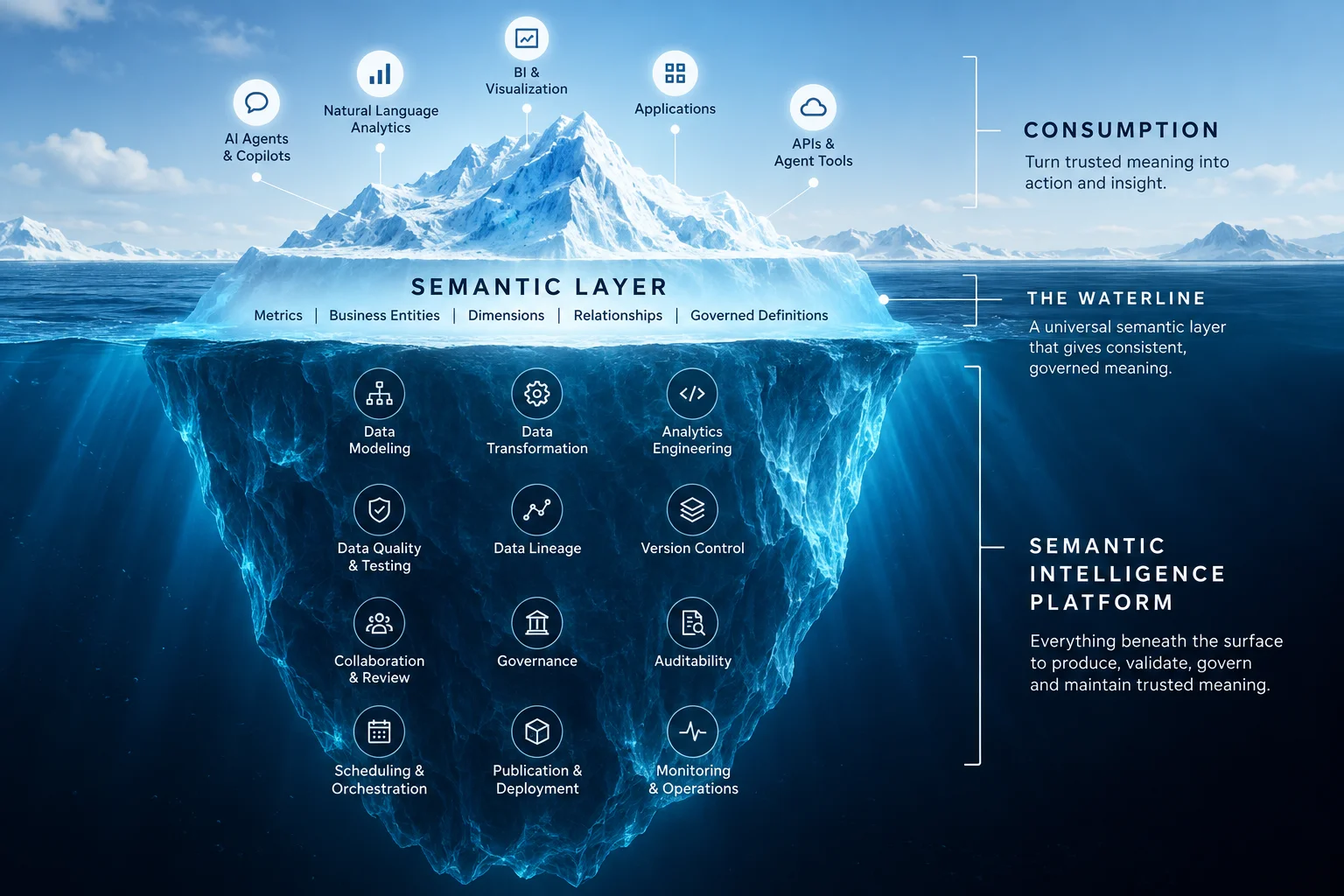
It isn't. The semantic layer is the waterline.
Above it are the things people interact with: AI agents, natural language interfaces, dashboards, applications, and APIs. Those things consume meaning. At the waterline, the semantic layer defines that meaning through metrics, entities, dimensions, relationships, and governed business definitions.
Underneath all of that is a much larger body of work. That is where meaning becomes trustworthy.
What sits below the waterline
Before you can define a governed metric, somebody has to produce the data it depends on. Data has to be transformed. Models have to be designed. Relationships have to be understood, and business logic has to be encoded somewhere.
Then the work continues. Transformations need to be tested. Changes need to be reviewed. Definitions need to be versioned. Lineage needs to show where a number came from. Production assets need to be deployed and scheduled. Activity needs to be auditable. And when something changes upstream, somebody needs to understand what it affects downstream.
None of this disappears because we put a semantic layer on top of the warehouse. Semantic systems make these capabilities more important.
If an AI agent can ask a semantic layer for revenue, generating the SQL is the easy part. The harder questions are:
- Is this the approved definition of revenue?
- What transformations produced it?
- Were those transformations tested?
- What source systems contributed to the result?
- Who changed the logic, and was the change reviewed?
- Which version is currently in production?
- What other metrics depend on it?
Those are operational governance problems.
Semantic layers start where the hard work supposedly ends
Most semantic layer products establish an abstraction over data that has already been prepared for them. They assume the transformation layer exists somewhere else. Modeling happens somewhere else. Testing happens somewhere else. Lineage comes from another system, orchestration belongs to another tool, version control and deployment live in another workflow, and auditing is somebody else's concern.
Nothing is wrong with that architecture. Specialized tools can work well together. But it puts the semantic layer in a very particular place in the stack: at the waterline.
Increasingly, vendors are expanding upward from there. They add natural language interfaces. They add agents. Some are bringing visualization back into the semantic layer. Others expose semantic models as APIs or tools that AI systems can call.
That makes sense. But almost all of that activity is happening above the waterline.
Coginiti goes the other direction too
This is one of the reasons we describe Coginiti as a Semantic Intelligence Platform rather than simply a semantic layer. Coginiti includes the semantic layer, and it also includes much of the machinery required to create and operate what that layer exposes:
- Produce: data transformation, data modeling, and analytics engineering
- Validate: data quality testing and lineage
- Govern: version control, collaborative review, governance, and auditability
- Maintain: scheduling and orchestration, publication and deployment, monitoring and operations
These capabilities sit below the semantic layer because they produce, validate, govern, and maintain the meaning that eventually gets exposed to people and machines. Above the semantic layer, that governed meaning is consumed through AI agents, BI tools, applications, APIs, and other analytical experiences.
The result is a system for managing the lifecycle of analytical meaning, from the first transformation to the answer an agent gives.
Trust lives below the waterline
As organizations deploy more AI agents, it is tempting to focus on the visible experience: ask a question, get an answer, generate a chart, build an agent. Those are the things people see.
But the quality of that experience depends on infrastructure they don't see. An agent can only give a trustworthy answer if the definitions it uses are trustworthy. Those definitions are only trustworthy if the data, models, transformations, tests, governance processes, and operational controls beneath them are trustworthy too.
See Semantic Intelligence in Action
Coginiti operationalizes business meaning across your entire data estate.